
Why might your savings account be losing value without you knowing?
Why your savings account may be losing value, even when your balance grows, and how inflation, APY, taxes and fees affect your real return.
Warning: your savings account might be making you lose money
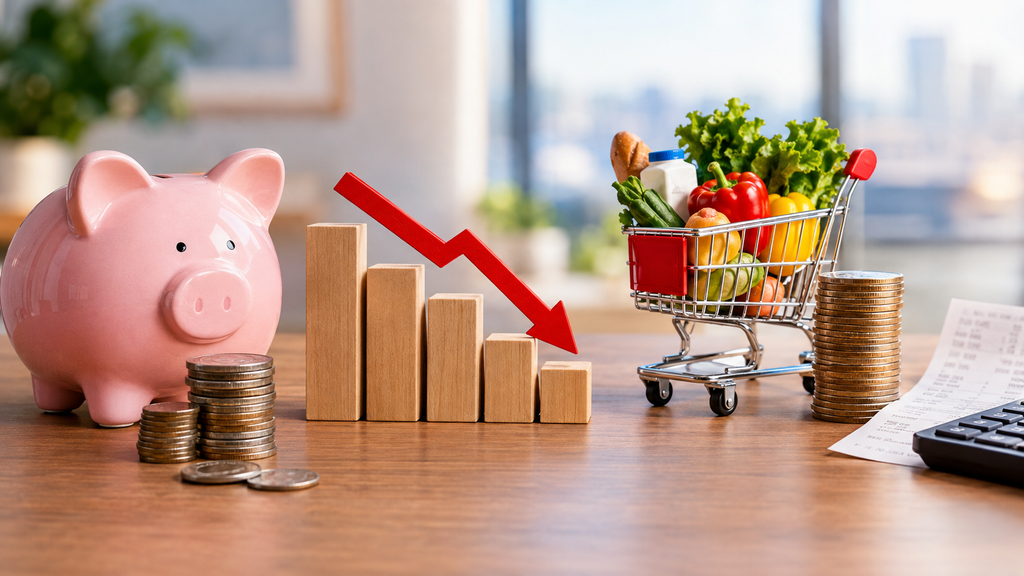
If your savings account balance is growing every month, it is easy to assume your money is doing its job.
But a higher dollar balance does not automatically mean you are gaining purchasing power.
That means the question is not simply, “Is my savings account earning interest?”
The more important question is: Is the interest your savings account earns enough to protect the purchasing power of your money after inflation and taxes?
Why Can a Savings Account Lose Value?
A savings account can lose value in real terms when the rate you earn is lower than the rate at which prices are rising.
Your bank statement may show a slightly larger balance, but if everyday expenses are increasing faster than your savings are growing, that money buys less than it did before.
- A simple way to think about it is: Real return ≈ savings APY − inflation rate;
- For a more precise calculation: Real return = (1 + APY) ÷ (1 + inflation) − 1
For example, if your savings account earns 0.64% APY while inflation is 3.4%, your approximate real return before taxes is about -2.67%.
Your balance has not necessarily fallen in dollars. Its purchasing power has.
Your Savings Account APY May Be Too Low
One of the biggest reasons Americans lose purchasing power on cash is simply earning too little interest.
The national average savings account rate differs by methodology and source. NerdWallet currently reports 0.37%, while Bankrate’s September 24 survey reports 0.64%.
Both figures illustrate the same issue: the average rate is far below the current inflation rate of 3.4%.
The gap becomes particularly important at large traditional banks, where savings accounts can pay extremely low APYs.
Inflation Can Quietly Reduce Your Purchasing Power
Inflation does not remove money from your bank account. Instead, it reduces what each dollar can buy.
The latest available U.S. Consumer Price Index data for August 2026 showed prices rising 3.4% over the previous 12 months.
Energy was an important contributor, with gasoline prices rising 3.9% in August alone.
The real-return figures use the more precise inflation-adjusted calculation and are rounded.
This table also explains why “my account earned interest” is not the same as “my money grew in real terms.”
What Is Happening to Savings Account Rates in September?
September has brought an unusual development for savers: the Federal Reserve raised, rather than cut, its benchmark rate.
On September 16, 2026, the Federal Open Market Committee increased the federal funds target range by a quarter percentage point to 3.75%–4.00%.
The Fed said inflation remained elevated and that the decision was intended to support a return toward its 2% inflation goal.
Because savings rates often respond to changes in the federal funds rate, the move can affect what banks pay depositors.
NerdWallet reported that several high-yield savings accounts increased their rates following the September 16 decision.
But this does not mean every savings account automatically becomes more competitive.
Traditional Savings Accounts and High-Yield Accounts Are Very Different
The difference between a traditional savings account and a high-yield savings account can be substantial.
CNBC Select reported on September 23 that its highest listed high-yield savings rate was 4.21% APY, compared with a national average of 0.37%, making the top rate more than 11 times the national average.
Bankrate’s September 24 survey, using a different methodology, put the national average at 0.64% APY.
That difference between sources is worth understanding rather than ignoring: rate averages depend on the institutions and methodology included in each survey.
The practical lesson is simpler: don’t assume your bank’s APY is competitive just because it is called a savings account.
The comparison is not a forecast. It simply illustrates how the APY you accept can materially affect the amount of interest your cash generates.
Can Taxes Make Your Savings Account Worth Less?
Yes. Even if your savings account earns more than inflation before taxes, your after-tax return can be lower.
Interest from bank accounts is generally taxable as ordinary income under federal tax rules.
The IRS classifies interest received from bank accounts as taxable interest, and banks generally report qualifying interest on Form 1099-INT.
Your APY Is Not Necessarily Your Real After-Tax Return
Suppose you have a savings account paying 4.00% APY.
At a hypothetical 22% federal marginal tax rate, ignoring state taxes, the interest remaining after federal income tax would be approximately:
4.00% × (1 − 0.22) = 3.12%
If inflation were 3.4%, your approximate after-tax return would therefore be negative.
This does not mean a 4% savings account is “bad.” It demonstrates why comparing APY alone can give an incomplete picture.
Are Fees Eating Into Your Savings Account Returns?
Interest is not the only number worth checking.
A monthly maintenance fee, minimum-balance penalty or other account charge can reduce or completely eliminate the interest you earn.
For example, an account earning 0.50% APY on $10,000 produces approximately $50 in annual interest before taxes. A $5 monthly fee would cost $60 per year, more than the interest earned.
That is why a competitive savings account should be evaluated based on net earnings, not simply its advertised APY.
Check These Savings Account Details
Before deciding that your account is competitive, check:
- APY: How much interest does the account actually pay?
- Monthly fees: Is there a maintenance charge?
- Minimum balance: Do you need to maintain a certain balance to earn the advertised APY?
- Rate conditions: Is the APY available to everyone or only under specific conditions?
- Withdrawal or transfer rules: Are there restrictions or fees?
- Rate variability: Can the bank change the APY?
- Deposit insurance: Is the institution FDIC-insured?
- Tax treatment: How much of your interest will remain after taxes?
CNBC Select’s September 2026 guidance similarly emphasizes that APY is only one factor when evaluating a high-yield savings account; fees, minimum deposits, accessibility and account features also matter.
Is Your Savings Account Still a Good Place for Emergency Cash?
A low real return does not automatically mean you should move emergency savings into a riskier investment.
A savings account serves an important purpose: liquidity and stability.
For money you may need unexpectedly — such as an emergency fund, upcoming medical expense, home repair or near-term purchase — easy access can matter more than maximizing long-term investment returns.
FDIC insurance also protects eligible deposits at insured banks, generally up to $250,000 per depositor, per insured bank, per ownership category. Savings accounts are among the deposit products covered by FDIC insurance.
The issue, therefore, is not necessarily whether you should have savings.
It is whether your savings account is doing the job you expect it to do.
H3: When a Savings Account Makes Sense
A savings account can be particularly appropriate for:
- An emergency fund
- Money needed within the next few months
- A short-term financial goal
- Cash you cannot afford to expose to market volatility
- Money that needs to remain readily accessible
The goal is not necessarily to turn emergency savings into an investment portfolio.
The goal is to avoid leaving significant cash in an account that pays so little that inflation steadily reduces its purchasing power.
How to Tell If Your Savings Account Is Losing Value
You can perform a quick check in a few minutes.
Step 1 — Find Your Current APY
Log into your bank account and find the current APY, not just the interest amount credited during the last month.
The APY tells you the annualized yield, including the effect of compounding.
Step 2 — Compare It With Current Inflation
The latest August 2026 CPI reading showed annual inflation of 3.4%.
If your savings APY is substantially below 3.4%, your money is generally losing purchasing power before taxes, assuming that inflation rate remains representative.
That does not mean the result will be identical every month. Inflation changes, and savings APYs can change as well.
Step 3 — Compare Your Rate With Other Savings Accounts
September 2026 data show just how wide the spread can be.
NerdWallet’s current national average is 0.37%, while its selected high-yield accounts average 3.66%. CNBC Select lists a top rate of 4.21%, while Bankrate’s national average is 0.64%.
You do not need to chase the single highest advertised rate.
Instead, compare APY, fees, conditions, access and insurance.
Step 4 — Calculate the After-Tax Picture
If you earn $500 in interest, you may not get to keep the full $500.
Estimate your federal and, where applicable, state tax impact to understand how much your savings are actually earning.
This is particularly important for larger balances.
Step 5 — Check Your Account Again Periodically
Savings rates are not fixed forever.
Bankrate notes that savings account APYs can change as the broader interest-rate environment changes.
That means a competitive account today may become less competitive later.
A simple review every few months can help you catch a rate that has fallen significantly relative to alternatives.
What September 2026 Means for Savers
September is particularly relevant because several developments have converged.
The Federal Reserve raised rates on September 16, while August inflation came in at 3.4%. At the same time, high-yield savings rates remain substantially higher than the national average offered by many traditional savings accounts.
The Fed’s September projections put median PCE inflation at 3.7% for 2026, followed by 2.3% in 2027 and 2.1% in 2028. These are policymakers’ projections, not guarantees.
For savers, that means the interest-rate environment remains important to watch.
Author’s opinion
A savings account should not be judged solely by whether the number on your statement is going up.
In my view, the more useful question for a saver is: “What is my money actually able to buy after interest, inflation and taxes?”
That distinction matters because there is a psychological trap in watching a bank balance increase.
Seeing interest credited to your account can create the impression that your money is automatically growing in real terms.
If your savings account earns 0.01%, 0.37% or 0.64% while inflation is running at 3.4%, the purchasing power of that cash is under pressure.
By contrast, a competitive high-yield savings account can provide a much stronger defense against inflation, although its rate can change and taxes still matter.
That does not mean every saver should constantly move money chasing the highest APY.
It means you should know what you are earning, what you are paying, how much inflation is reducing purchasing power and how much of your interest you actually keep.
Your savings account may still be exactly the right place for your emergency fund or short-term cash.
A five-minute review of your APY, fees, inflation exposure and tax impact can tell you whether your savings account is actually protecting the money you worked to save.

Recommended Content
Why your grocery budget isn’t going as far anymore
Learn what’s driving food prices, which groceries are rising and how to identify what’s hurting your budget.
Continue reading * You will remain on the current website Why your grocery budget isn’t going as far anymore
Continue reading You will remain on the current website