Is your grocery bill high? See what’s causing it
The grocery bill is high. Learn what's driving food prices, which groceries are rising and how to identify what's hurting your budget.
Why your grocery budget isn’t going as far anymore
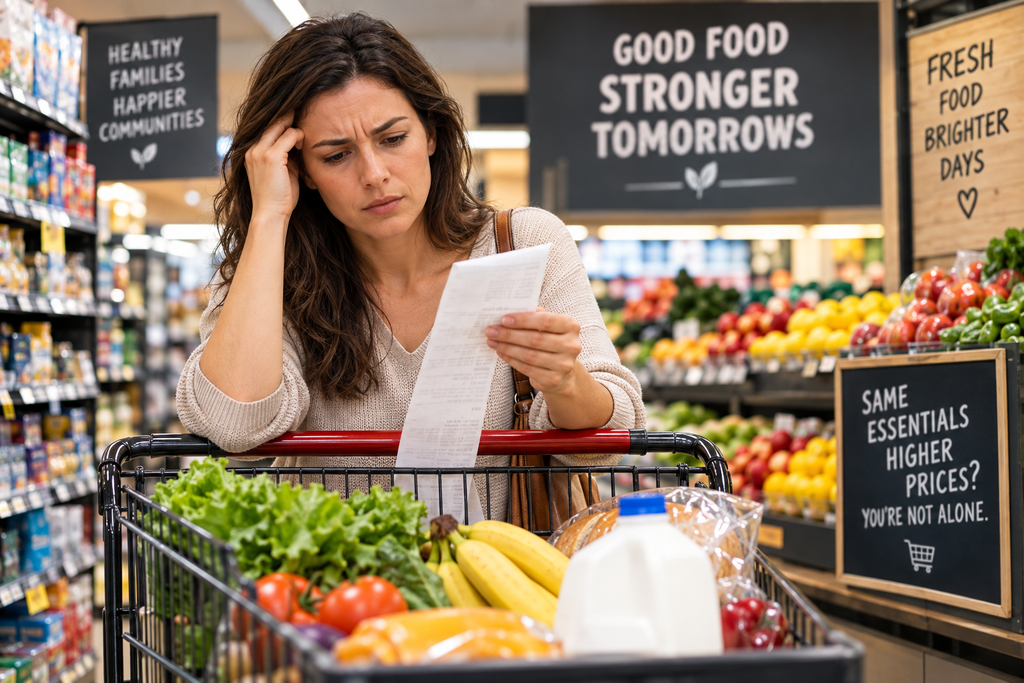
The grocery bill is high because food prices in the U.S. remain significantly above pre-pandemic levels, even though the pace of grocery inflation has slowed.
Prices for food purchased for consumption at home were 2.2% higher than a year earlier, according to the U.S. Bureau of Labor Statistics (BLS).
That means a slower inflation rate does not necessarily mean your supermarket trip will cost less. It means prices are increasing more slowly than before.
For American households already balancing rent, utilities, transportation, healthcare and other everyday expenses, that distinction matters.
So, why is your grocery bill still high? Several factors are contributing, including higher cumulative food prices.
Why Is the Grocery Bill So High in 2026?
The grocery bill is high because food prices have accumulated years of increases, while individual grocery categories continue to move at different rates.
The USDA Economic Research Service (ERS) forecasts that food-at-home prices will increase 2.5% in 2026, although the agency’s forecast includes a range of uncertainty.
The important point is that the national average does not tell the whole story.
Grocery inflation is slowing, but grocery prices are still elevated
Inflation measures how quickly prices change. It does not measure whether prices have returned to their previous level.
For example, if a product costs $5 and rises to $6, the price remains $6 even if inflation later falls to zero.
That is essentially what many American shoppers are experiencing.
NerdWallet’s analysis of BLS data found that food prices were 33.4% higher in March 2026 than in March 2020, while average hourly earnings had increased 31.9% during the same period.
Bottom line: slower food inflation does not mean groceries have returned to 2020 prices.
What Is Making Groceries More Expensive?
Several forces can affect grocery prices simultaneously.
The biggest issue for consumers is that not every food category responds to the same economic pressure at the same time.
Beef prices are putting significant pressure on grocery budgets
Beef is one of the clearest examples of why the grocery bill is high for some households.
According to the USDA ERS, beef and veal prices were 9.4% higher in July 2026 than in July 2025. The USDA’s 2026 forecast calls for beef and veal prices to increase 9.8%.
The USDA also reported that federally inspected beef production declined by almost 5% in July, contributing to tighter supplies and elevated wholesale beef prices.
For families that regularly purchase ground beef, steaks or other beef products, this can have a much bigger effect than the overall grocery inflation rate.
Transportation and energy costs can affect the food supply chain
Food doesn’t go directly from a farm to your kitchen.
It can pass through farms, processors, warehouses, refrigerated trucks, distribution centers and supermarkets.
Those operations require transportation and energy.
In August 2026, the BLS reported that the energy index was 16.3% higher than a year earlier, while motor fuel was up 27.9%.
Energy costs are only one factor in food prices, so it would be inaccurate to attribute every grocery increase to fuel.
However, transportation and energy costs can add pressure throughout the supply chain.
Which Grocery Prices Are Rising the Fastest?
The grocery categories experiencing the biggest increases are not necessarily the same categories every household buys most often.
That is why looking at the national grocery index alone can be misleading.
Nonalcoholic beverages
Nonalcoholic beverages were 3.7% more expensive in August 2026 than a year earlier, according to the BLS.
For households purchasing bottled water, soft drinks, juice or other beverages frequently, repeated increases can add up over the course of a month.
Fruits and vegetables
The fruits and vegetables category was 3.2% higher year over year in August. However, prices also declined 0.4% from July to August.
That illustrates an important feature of grocery shopping: prices can rise over the year while falling from one month to the next.
Eggs
Egg prices are another example of why consumers need to look at both monthly and yearly changes.
Egg prices rose 2.9% in August 2026, but they remained 23.0% below their level a year earlier, according to data analyzed by NerdWallet.
So if you notice eggs becoming more expensive compared with last month, that doesn’t necessarily mean they are experiencing annual inflation.
Why Does My Grocery Bill Feel Higher Than the Inflation Rate?
Your grocery bill can increase faster than the national food-at-home inflation rate because your shopping basket is different from the basket used to calculate the national average.
This is one of the most important answers for consumers searching, “Why is my grocery bill so high?”
Your shopping habits determine your exposure to food inflation
Imagine two households. Household A buys mostly:
- Rice
- Pasta
- Dairy
- Chicken
- Store-brand products
Household B buys mostly:
- Beef
- Fresh produce
- Branded snacks
- Beverages
- Specialty products
Both households experience the same national economy, but their grocery bills can move very differently.
The food you buy matters as much as the national inflation rate.
The national CPI is not your personal grocery inflation rate
The BLS Consumer Price Index measures price changes for a representative basket of goods and services.
It does not calculate the exact inflation rate experienced by your household.
That’s why a 2.2% national increase in food-at-home prices doesn’t mean your personal grocery bill will increase exactly 2.2%.
How Much Should an American Family Spend on Groceries?
There is no single grocery budget that works for every American household.
Household size, age, location, dietary needs and shopping habits all affect food spending.
The USDA publishes food-at-home plans at different spending levels.
NerdWallet’s analysis of USDA figures estimated that a family of four following the USDA Thrifty Food Plan would spend roughly $1,013 per month, or more than $12,000 annually.
That figure should be treated as a benchmark, not a mandatory spending limit.
A better question than “What should groceries cost?”
Instead of asking: “How much should my grocery bill be?”
Ask: “Which categories are making my grocery bill higher?”
That question produces a more actionable answer because it connects national food-price trends with your actual spending.
How Can You Lower a High Grocery Bill?
The most practical way to lower a high grocery bill is to identify which categories are consuming the most money and then target those categories first.
After four weeks, look for the categories responsible for the largest share of your spending.
Compare unit prices
The shelf price isn’t always the most useful number.
Compare the price per ounce, pound, quart or other standard unit when choosing between different package sizes and brands.
A larger package can have a lower unit price, but only if you will actually use the product.
Build meals around lower-cost options
USDA forecasts show that food categories can behave very differently.
For example, beef and veal are forecast to experience much faster price growth in 2026 than some other protein categories.
That gives shoppers an opportunity to create more flexible meal plans.
If beef is particularly expensive one week, you might build some meals around another protein already on your shopping list.
The goal isn’t to eliminate foods you enjoy.
It’s to avoid allowing one expensive category to dominate your entire grocery budget.
Use discounts strategically
Coupons, loyalty programs and cash-back offers can reduce the effective cost of groceries.
But a discount only helps your budget if it reduces the cost of something you actually planned to buy.
CNBC Select recommends strategies such as taking advantage of store deals and changing shopping habits to reduce grocery spending.
Bankrate has also examined grocery rewards and credit-card strategies that can offset part of the cost of everyday purchases.
A 20% discount on something you don’t need is still spending money.
What Does September Mean for Grocery Spending?
September can create additional pressure on some household food budgets because it coincides with back-to-school spending and the beginning of fall routines.
Families may be buying more lunch ingredients, snacks and drinks, while Labor Day gatherings can add another round of food purchases.
Back-to-school shopping can increase food spending
The return to school can change a household’s weekly shopping pattern.
Instead of purchasing only dinners, families may also need:
- Lunch ingredients;
- Packaged snacks;
- Breakfast foods;
- Drinks;
- School-friendly portions.
The easiest way to prevent these expenses from quietly expanding the budget is to include them in the grocery plan before shopping.
Labor Day can create a temporary grocery spike
Labor Day was observed on September 7, 2026.
Cookouts and gatherings can increase demand for meat, beverages, snacks and other foods.
Rather than treating those purchases as part of a normal weekly grocery trip, consider them a separate seasonal expense.
What Will Happen to Grocery Prices for the Rest of 2026?
The USDA currently forecasts that food-at-home prices will increase 2.5% in 2026.
The forecast range is approximately 1.7% to 3.3%, reflecting uncertainty around future conditions.
The important takeaway is that the USDA does not expect every grocery category to move at the same rate.
Several categories are projected to grow faster than their historical averages, including beef and veal, fish and seafood and fresh fruits, fresh vegetables.
Should consumers expect groceries to become cheaper?
Not necessarily.
A forecast for slower inflation does not mean supermarkets will return to the prices consumers remember from 2019 or 2020.
The more relevant question for household budgeting is whether individual food categories continue to rise and how heavily those categories feature in your shopping basket.
How to Find Out What Is Driving Your Grocery Bill
If you’re wondering why the grocery bill is high, use this simple process:
Step 1 — Compare your last four receipts
Look for products that have repeatedly increased in price.
Step 2 — Identify your biggest spending categories
Calculate approximately how much you spend on meat, produce, dairy, beverages and packaged foods.
Step 3 — Check the unit price
Compare brands and package sizes using the same unit of measurement.
Step 4 — Look for substitutions
If one category is unusually expensive, consider whether another product can serve the same purpose at a lower cost.
Step 5 — Recheck your budget next month
Food prices change.
A substitution that makes sense today may not make sense next month.
The goal is not to predict grocery prices perfectly. It’s to make your household budget respond to the prices you actually face.
Author’s Opinion
When the grocery bill is high, it’s easy to look at the receipt and assume everything at the supermarket has become equally expensive.
The national food-at-home index was up 2.2% year over year, but individual categories moved at very different rates.
Beef, beverages and produce can have a much greater effect on a particular household than the national average suggests.
That’s why the most useful first step isn’t necessarily cutting your entire grocery budget.
Recommended Content
Loan Rate Too High
Find out how the September 30 deadline can lower interest rates on eligible federal student loans through automatic payments.
Continue reading * You will remain on the current website