
Buy now, pay later: what is the risk to your credit score?
Does Buy Now, Pay Later hurt your credit score? Learn how BNPL affects credit reports, inquiries, late payments and collections.
The hidden risk of BNPL to your credit score
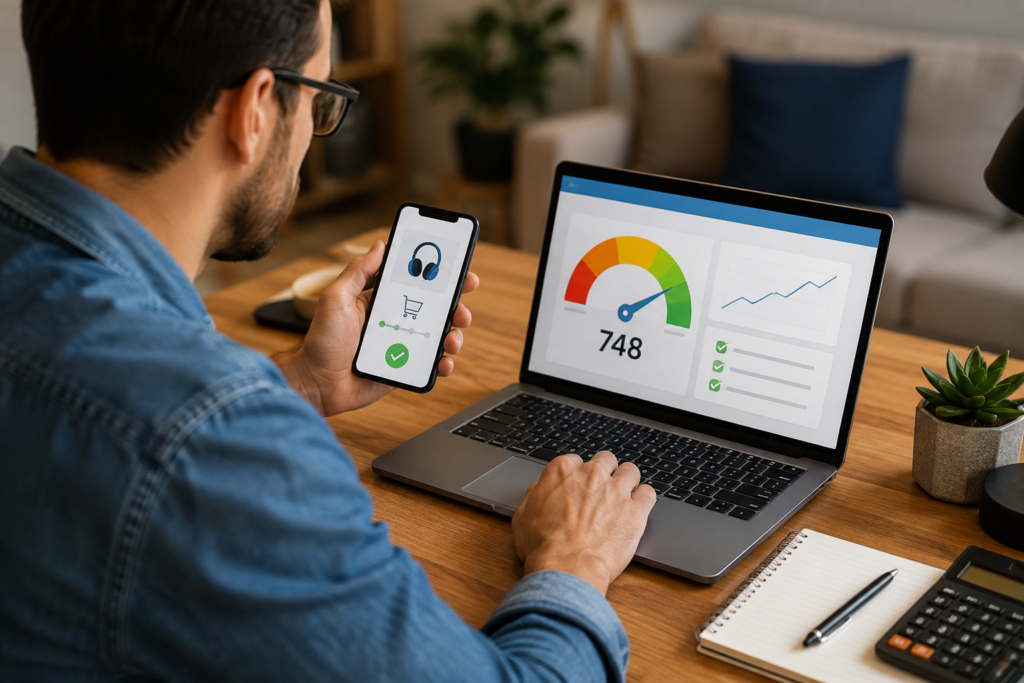
If you have ever chosen Buy Now, Pay Later (BNPL) at checkout because paying $25 today feels easier than paying $100 at once, you are far from alone.
BNPL has become a familiar way to split purchases into several smaller payments.
The problem is that a payment plan that feels simple at checkout can become more complicated when it comes to your credit score.
The good news is that using BNPL does not automatically hurt your credit.
For Americans managing tight budgets, credit card balances and back-to-school expenses, understanding that distinction matters.
Does buy now, pay later affect your credit score?
Yes, BNPL can affect your credit score, but the impact depends on the provider, the specific payment product and your payment behavior.
Historically, many pay-in-four BNPL loans were not reported to the major credit bureaus. As a result, paying off a BNPL purchase on time often did not help build your credit, but the account also generally did not hurt your score.
The Consumer Financial Protection Bureau (CFPB) says most traditional pay-in-four BNPL products historically have not reported payment history to nationwide consumer reporting companies.
Meanwhile, credit reporting by BNPL companies has become more common.
Bankrate reports that Affirm began reporting its payment plans to Experian and TransUnion, while NerdWallet notes that credit reporting remains inconsistent among BNPL providers.
Can paying BNPL on time improve your credit?
Potentially, yes.
If a BNPL provider reports your account and payment history to a credit bureau or if the information is incorporated into a scoring model that uses BNPL data.
However, you should not assume that every BNPL payment helps your score.
The CFPB says that most traditional pay-in-four BNPL loans have historically not been reported, meaning timely payments generally did not build credit in the same way as a traditional credit card or installment loan.
Making payments on time is always a good financial practice, but that does not mean every BNPL payment will be recorded as a positive credit history.
HCan missing a BNPL payment hurt your credit?
Yes, it can.
If the provider reports late payments, missed payments can appear on your credit report and potentially damage your credit history.
Even when a provider does not immediately report a late payment, failure to repay can lead to late fees, account restrictions or collections.
If the debt is sent to a debt collector and reported to a credit reporting company, it can hurt your credit score.
This is why the absence of an immediate credit-score impact should never be interpreted as an absence of financial risk.
Why BNPL Is Becoming More Relevant to Credit Scores in 2026
The BNPL market is no longer a small niche used occasionally for online purchases.
The CFPB’s latest market analysis found that the six large BNPL companies included in its study had 53.6 million consumers using BNPL in 2023, up 12% from 2022.
The average consumer took out 6.3 BNPL loans per lender in 2023, while the average annual dollar amount borrowed per lender rose to $848.
At the same time, the credit-scoring ecosystem is evolving.
That matters because a BNPL purchase that once had little or no visibility in traditional credit scoring may increasingly become part of how lenders evaluate a consumer.
The exact impact will depend on which scoring model a lender uses, what data is available and how the BNPL provider reports it.
FICO and BNPL data
FICO announced new credit-scoring products that incorporate BNPL transactions after working with Affirm to understand how this type of repayment behavior could be used in credit risk assessment.
This does not mean that every BNPL purchase will suddenly reduce your FICO score.
Instead, it signals a broader shift: BNPL activity is becoming more relevant to the credit ecosystem.
For consumers, the practical lesson is simple.
Don’t assume that a BNPL purchase is permanently invisible to lenders simply because it did not affect your credit score in the past.
What Are the Biggest BNPL Risks to Your Credit?
The biggest risks are not limited to one missed payment.
BNPL can affect your credit profile through hard inquiries, reported payment history, collections and excessive use of multiple plans.
| BNPL factor | Potential credit impact | What consumers should know |
|---|---|---|
| Soft credit inquiry | Usually no score impact | Common with many BNPL applications |
| Hard credit inquiry | May cause a temporary score drop | Depends on the product and provider |
| On-time payments | May help if reported | Not every provider reports payments |
| Late payments | Can hurt if reported | Policies vary by provider |
| Collections | Potentially significant negative impact | Unpaid debt may be sent to collections |
| Multiple BNPL plans | Indirect financial risk | Can make it easier to overextend your budget |
| Long-term BNPL loan | Greater potential credit visibility | May be treated differently from pay-in-four plans |
The CFPB specifically warns that consumers should review the terms of the BNPL product before accepting it because credit checks and reporting practices vary.
Hard vs. soft credit checks
This distinction is easy to overlook.
A soft credit inquiry generally does not affect your credit score. A hard inquiry can cause a temporary decrease in your score.
Many standard BNPL products use soft inquiries or no traditional credit inquiry at all. But some longer-term financing products may use hard inquiries.
Bankrate gives the example of Affirm’s longer-term installment loans and PayPal Credit, which can involve a full credit check.
Late payments and collections
The most obvious risk is failing to pay.
According to the CFPB, BNPL providers commonly charge late fees, may restrict further purchases and can send unpaid debt to collections.
If the debt collector reports the account to a credit reporting company, the negative information can affect your credit scores.
The risk is particularly important for consumers who use BNPL because their monthly budget is already stretched.
A $50 installment may look manageable in isolation. But five different $50 payments due around the same time represent $250 of financial obligations.
That is where BNPL can become less about one purchase and more about cash-flow management.
The Hidden BNPL Risk: Loan Stacking
One of the most important issues for BNPL users is loan stacking, which means having multiple BNPL loans at the same time.
CFPB research found that approximately 63% of BNPL borrowers had multiple simultaneous loans at some point in 2022, while about 33% borrowed from multiple BNPL companies.
This matters because your budget does not care whether the money is owed to Klarna, Affirm, PayPal, Afterpay or another provider.
The payments still come out of the same checking account.
The problem can become even harder to see when BNPL accounts are not consistently reported to the credit bureaus.
Historically, lenders may not have had a complete picture of a consumer’s outstanding BNPL obligations.
Why multiple BNPL plans can become dangerous
Imagine that you have:
- $40 due for clothing
- $75 due for electronics
- $35 due for groceries
- $50 due for a household purchase
None of those payments seems overwhelming by itself.
Together, however, they represent $200 in additional obligations.
If those payments overlap with rent, utilities, a car payment, student loans and credit card bills, one missed payment can create a chain reaction.
The CFPB found that BNPL borrowers were also more likely to carry higher balances on other unsecured credit accounts, including credit cards and personal loans.
That does not prove BNPL causes financial distress.
In fact, the CFPB cautions that its data cannot determine whether BNPL usage leads to delinquency or whether consumers already experiencing financial pressure are more likely to use BNPL.
But the connection is important enough to warrant attention.
Author’s Opinion
BNPL is not inherently a financial trap, but the “small payment” mentality can make a large financial obligation feel smaller than it really is.
That is the central issue consumers should understand.
The most important change in 2026 is that BNPL is becoming increasingly visible within the credit ecosystem.
Reporting practices are evolving, FICO has introduced models incorporating BNPL data, and major providers are making different choices about how payment activity is reported.
For someone who uses BNPL once to spread out a necessary purchase and has the money available for every installment, the risk may be relatively limited.
The situation becomes more concerning when BNPL is used to make purchases that would otherwise be unaffordable, particularly when several plans overlap.
Your credit score is only one part of the equation. Your monthly cash flow is what ultimately has to support all of those payments.

Recommended Content
Tax-free school shopping: save more in 2026
Learn how tax-free weekends work, what qualifies and how to maximize your savings.
Continue reading * You will remain on the current website