
More expensive car insurance: why does the price keep rising in the U.S.?
Why is car insurance so expensive? Learn what's driving U.S. premiums in 2026 and what you can do to lower your auto insurance costs.
Did your car insurance go up without you changing anything? Find out why
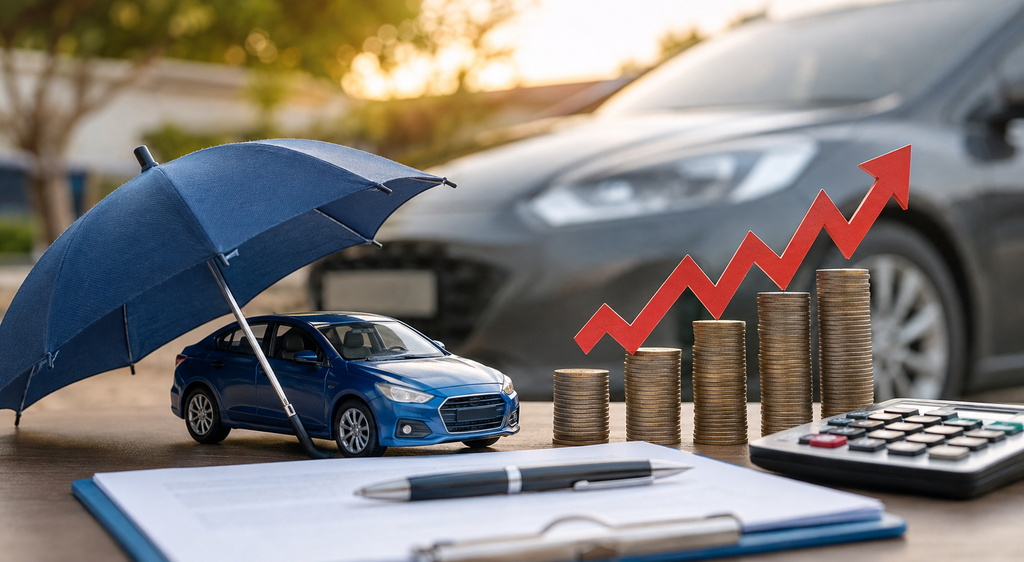
If your car insurance renewal arrived with a higher premium, you may be wondering what changed.
Maybe you had no accident, no speeding ticket and no change in coverage, yet your monthly bill still went up.
The answer is that insurers price policies based on expected claims costs, and those costs vary significantly by state, vehicle, driving history, claims frequency and other factors.
A national average can fall while your individual premium rises.
Is car insurance actually getting more expensive in 2026?
The short answer is: not everywhere, and not at the national level right now.
The latest Consumer Price Index data from the U.S. Bureau of Labor Statistics show that motor vehicle insurance prices fell 4.5% over the 12 months ending in July 2026.
That is a significant change from the double-digit increases many drivers experienced between 2022 and 2025.
At the same time, insurance remains one of the largest recurring costs of owning a vehicle.
Different publishers report different averages because they use different insurers, driver profiles, coverage limits and methodologies.
The important point is not that there is one universal “average,” but that a typical full-coverage policy can represent thousands of dollars a year for an American household.
Why can my premium increase if national insurance prices are falling?
Because your insurance premium is not based on the national average.
Your insurer evaluates the expected cost of covering your risk profile and the risks in your market.
State regulations also determine how insurers can set and change rates.
The National Association of Insurance Commissioners (NAIC) identifies factors including:
- Your driving record;
- Claims history;
- Location;
- Age and driving experience;
- Vehicle type;
- Annual mileage;
- Coverage limits;
- Deductible;
- Previous insurance coverage;
- Credit-based insurance factors where permitted;
- Vehicle use;
- Telematics or driving behavior data.
That means a national decline in insurance prices does not guarantee a lower renewal price for every driver.
Why is car insurance still so expensive in the U.S.?
The biggest reason is simple: insurance companies are ultimately pricing the expected cost of future claims.
When crashes, vehicle repairs, medical treatment, lawsuits, theft or weather-related losses become more expensive, insurers need to account for those costs when setting premiums.
Car repairs are becoming more expensive
One of the biggest pressures on auto insurance is the cost of repairing modern vehicles.
The BLS reported that motor vehicle maintenance and repair prices were 6.6% higher year over year in July 2026.
That matters because a collision today can require considerably more than replacing a bumper.
Modern vehicles may contain:
- Cameras
- Radar sensors
- Advanced driver-assistance systems
- Electronic control modules
- Specialized glass
- Complex lighting systems
- High-voltage components in electric vehicles
A relatively minor crash can therefore generate a much larger repair bill.
The NAIC specifically identifies repair costs, labor costs and parts availability as factors that can push insurance premiums higher.
New vehicle technology can increase claim costs
Newer cars are safer in many ways, but safer does not necessarily mean cheaper to repair.
Advanced driver-assistance systems can require calibration after an accident. Sensors may need to be replaced even when the visible damage looks relatively minor.
Electric vehicles can create additional repair considerations because of their batteries, specialized components and the availability of qualified repair facilities.
The NAIC notes that EVs can cost more to insure because of factors such as higher vehicle values, specialized repairs, battery replacement costs and limited repair facilities.
This is one reason your car’s make and model can matter almost as much as your driving record.
Medical and liability costs also affect premiums
Car insurance does not only pay for damage to vehicles.
Liability coverage can pay for injuries, medical expenses and property damage caused to other people. When medical treatment becomes more expensive, the cost of settling injury claims can also rise.
There is another factor: litigation.
The NAIC describes social inflation as increases in liability claim costs that exceed general economic inflation.
With litigation trends and larger jury awards among the factors contributing to higher costs.
For insurers, higher claim severity means that the same number of accidents can produce larger payouts.
Severe weather can make insurance more expensive
Weather is another major variable, particularly in states exposed to hurricanes, hail, flooding and severe storms.
The NAIC lists extreme weather events among the factors that can increase auto insurance losses because storms can generate large numbers of vehicle claims at the same time.
August is especially relevant because it falls within the most active portion of the Atlantic hurricane season.
Even though NOAA’s updated 2026 outlook calls for a below-normal Atlantic season, that does not eliminate localized risk.
A single severe storm can generate substantial claims in an affected area.
Location can dramatically change what you pay
Two drivers with the same age, car and driving record can receive very different insurance quotes simply because they live in different places.
Insurers consider factors such as:
- Accident frequency;
- Traffic density;
- Vehicle theft;
- Weather;
- Repair costs;
- Medical costs;
- Litigation;
- Local insurance regulations.
That is why asking “Why is car insurance so expensive?” without considering where you live can produce an incomplete answer.
What factors can make your car insurance premium increase?
Not every rate increase comes from broader economic conditions.
Sometimes the reason is much closer to home.
H3: Your driving record
Tickets and accidents can increase your premium because they may signal a higher likelihood of future claims.
These are averages, not guaranteed increases. Your actual rate depends on your insurer and state.
Your credit-based insurance score
In many states, insurers can use credit-based insurance information as one factor in determining premiums.
The NAIC says that insurers use credit information to help estimate the likelihood that a consumer will file a claim where the practice is permitted.
However, this is not allowed or treated the same way in every state, so consumers should check their state’s rules.
Your vehicle
A car’s purchase price is not the only factor that matters.
Insurers may consider:
- How expensive the vehicle is to repair;
- How often that model is stolen;
- Its claims history;
- Safety features;
- Replacement-part costs;
- Repair complexity.
For example, Investopedia reported in August 2026 that the Subaru Outback was among the cheapest new vehicles to insure.
The difference demonstrates why the car you drive can have a major effect on your insurance bill.
H3: Your coverage and deductible
More coverage generally means more protection — and a higher premium.
Your price can change if you:
- Increase liability limits
- Add comprehensive coverage
- Add collision coverage
- Lower your deductible
- Add optional protection
- Add another driver to the policy
A higher deductible can reduce your premium, but it also means you will have to pay more out of pocket after a covered claim.
The NAIC recommends considering a higher deductible only if you can comfortably afford it when a claim occurs.
Is car insurance finally getting cheaper?
There are signs that the insurance market is becoming less expensive at the national level.
The July 2026 CPI report showed motor vehicle insurance down 4.5% year over year.
This is a sharp reversal from the period when auto insurance was one of the fastest-rising components of consumer inflation.
Bankrate’s analysis also found that full-coverage rates had increased substantially between 2023 and 2025, although the pace of increases had begun to slow.
This distinction matters: slower increases do not necessarily mean lower premiums.
And in 2026, the national data are now showing actual declines, but those declines are not evenly distributed across the country.
Why your renewal notice may not reflect national trends
Insurance companies do not reset every driver’s premium based on the latest CPI report.
Rates are developed using underwriting models, claims experience, local conditions and state-approved rate filings.
There can also be a lag between changes in the cost of repairs, medical care and other claim expenses and the premiums consumers see.
How to lower your car insurance costs without losing important coverage
If your renewal is higher, you do not necessarily have to accept the first price you receive.
The goal is not simply to find the cheapest policy. It is to find the best price for comparable coverage.
Shop around before your renewal
This is one of the most effective steps.
NerdWallet recommends comparing rates regularly, including when major life circumstances change.
Get quotes from several insurers and compare the same:
- Liability limits
- Comprehensive and collision coverage
- Deductibles
- Uninsured/underinsured motorist coverage
- Optional coverage
A lower quote is not necessarily a better deal if it provides substantially less protection.
Ask your insurer to review available discounts
Discounts vary by company, but may include:
- Bundling policies
- Safe driving
- Defensive driving courses
- Good student discounts
- Low-mileage programs
- Vehicle safety features
- Telematics programs
- Claims-free discounts
Ask specifically which discounts you qualify for rather than assuming the insurer has already applied all of them.
Review your deductible
Increasing your deductible can reduce your premium.
But this strategy only makes sense if you have enough savings to cover the higher out-of-pocket amount after a claim.
Saving $20 a month is not necessarily a good trade if a $1,500 deductible would create a financial emergency.
Reconsider coverage on an older vehicle
If your vehicle has depreciated significantly, it may be worth reviewing whether comprehensive and collision coverage still makes financial sense.
The NAIC recommends considering the value of an older vehicle when deciding whether to maintain certain optional coverages.
However, do not automatically drop coverage.
If you finance or lease your vehicle, your lender may require comprehensive and collision insurance.
Avoid letting your policy lapse
A gap in coverage can make future insurance more expensive because insurers may view continuous insurance history as a positive rating factor.
If you are changing insurers, make sure the new policy begins before the old one ends.
What should you do if your car insurance suddenly goes up?
Before canceling your policy or reducing coverage, check your renewal notice carefully.
- Step 1 — Find out what changed;
- Step 2 — Ask the insurer why the price changed;
- Step 3 — Get competing quotes;
- Step 4 — Check your state’s insurance regulator.
What August means for drivers and insurance costs
August is a particularly useful month to review auto insurance because several seasonal factors intersect.
Back-to-school traffic
Across the U.S., schools begin returning to session during August and early September.
That changes traffic patterns, particularly around school zones, neighborhoods and morning and afternoon commute times.
NHTSA warns drivers to slow down in school zones, yield to pedestrians and stop for school buses when their lights and stop arms are activated.
Hurricane season is becoming more active
August also sits inside the core period of Atlantic hurricane activity.
NOAA identifies August through October as the peak months for the 2026 Atlantic hurricane season.
For drivers in hurricane- and storm-prone areas, comprehensive coverage can become particularly important because it may cover certain non-collision losses such as damage from storms.
That does not mean every driver needs every optional coverage. It means August is a good time to understand what your policy actually covers before severe weather arrives.
Author’s Opinion
The most important thing to understand about expensive car insurance is that the national average does not tell your whole story.
The data now show that motor vehicle insurance prices are falling nationally.
But that does not erase the financial pressure created by the increases drivers experienced in previous years, nor does it mean every state, vehicle or household is seeing lower premiums.
If your renewal went up despite having a clean driving record, do not immediately assume you did something wrong.
Your insurer may be responding to higher repair costs, local claims, weather exposure, vehicle-specific losses, medical costs or changes in its risk model.
At the same time, you should not assume that your current insurer is giving you the best possible price.
It should be to avoid paying more than necessary for the protection you actually need.

Recommended Content
End of ACA subsidies
Learn why health insurance costs are rising, who is most affected and how to compare your coverage costs.
Continue reading * You will remain on the current website